Interviste, Regno Unito, County of Kent, Canterbury, 03 March 2009
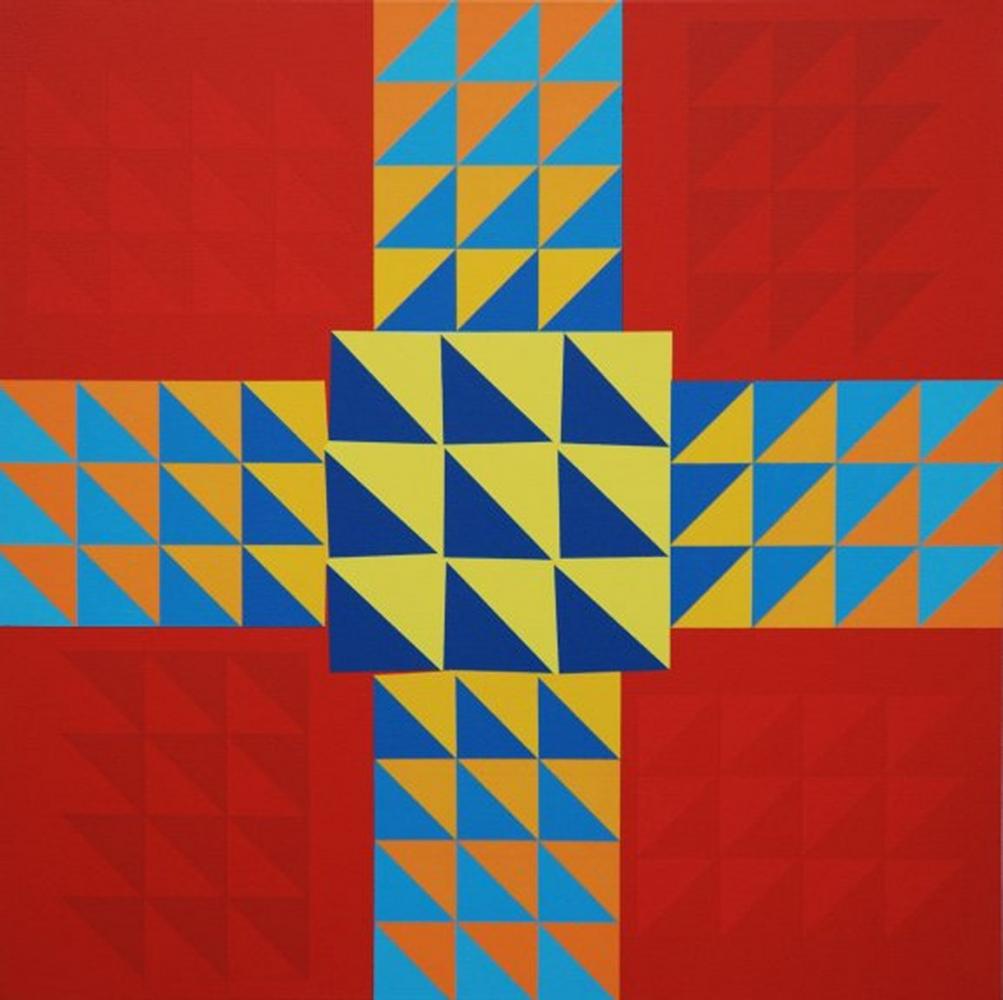
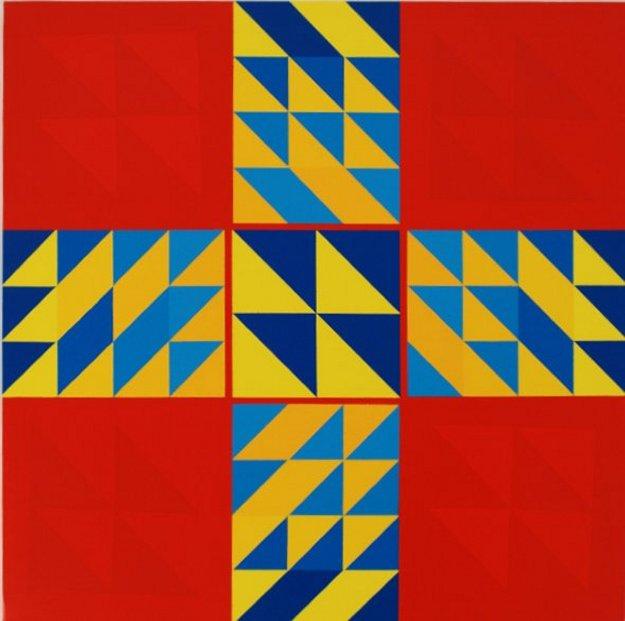
I worked on 3 series of paintings concerned with aspects of visual symmetry in 2007/08: Symmetry Rules (5 paintings); The Trouble with Symmetry (17 paintings); More Trouble with Symmetry (4 paintings). The first two of these series mainly explored the lay understanding of symmetry – e.g. how similar must displaced component images/patterns be for classification as ‘symmetrical’. The paintings typically present a simple, emblematic shape – a cross or an ‘x’ - which the casual observer will register as symmetrical by pre-conceived expectation. On closer scrutiny, a range of ‘anomalies’ will be found. As either a help or a hindrance (?) to such concentrated study, I began to paint-in some of the after-images likely to be generated by the higher contrast pattern sections; (and, anyway, in the 21st Century we expect everything on a plate, don’t we?). This device is intended to promote an additional visual dynamic as the observer’s eye/brain seeks to reconcile actual and representational after-images.
In More Trouble with Symmetry the emblematic shape used is based on that of a snowflake. As in nature, whilst each flake looks symmetrical, there are plenty of variations to be found along the edges of the spars.
The Perfect Symmetry series was begun in late 2008 and is in progress. These paintings play with the symmetry concept in both visual and language terms. Paintings completed so far are:
Flake at 34 Degrees (c & f)
This is a loose snowflake form, painted in warm red/orange hues. The nearest thing to actual (lay) symmetry here is in the title – 34 degrees Celsius is pretty hot – appropriate for such a glowing colour scheme: 34 degrees Fahrenheit as an ambient will allow a snowflake to lay a while before melting.
SixtyNine
A simple cross – so it should be symmetrical (?). The painted after-images are perhaps symmetrical – again, your call. However, you may argue that the only thing really symmetrical is the title, if considered in numeral form, 69.
St Lucian’s Conversion
Visual symmetry is most obviously evident in the 4 light painted after-images in the magenta fields – but is that real, or in your imagination? The painting’s title again provides a possibly more satisfying measure of symmetry – look up St Lucian and see what he was doing before he became a devout Christian!
Discovery of Saint Helena
Another cross – not particularly symmetrical in its visual componentry. Look for better symmetry in relation to the saint herself, the Southern Cross and the island.
Views on an Afterlife
You may think the concept passé in our current culture – if so, you probably also know that after-images are an illusion – but there seem to be some in this painting that don’t fade?
Saint Palinopsia’s Dilemma
Another cross, another saint . . but to look this one up, you may need a medical reference source. Symmetry? – what’s more symmetrical than image: after-image?
David Buckden
March 2009
In More Trouble with Symmetry the emblematic shape used is based on that of a snowflake. As in nature, whilst each flake looks symmetrical, there are plenty of variations to be found along the edges of the spars.
The Perfect Symmetry series was begun in late 2008 and is in progress. These paintings play with the symmetry concept in both visual and language terms. Paintings completed so far are:
Flake at 34 Degrees (c & f)
This is a loose snowflake form, painted in warm red/orange hues. The nearest thing to actual (lay) symmetry here is in the title – 34 degrees Celsius is pretty hot – appropriate for such a glowing colour scheme: 34 degrees Fahrenheit as an ambient will allow a snowflake to lay a while before melting.
SixtyNine
A simple cross – so it should be symmetrical (?). The painted after-images are perhaps symmetrical – again, your call. However, you may argue that the only thing really symmetrical is the title, if considered in numeral form, 69.
St Lucian’s Conversion
Visual symmetry is most obviously evident in the 4 light painted after-images in the magenta fields – but is that real, or in your imagination? The painting’s title again provides a possibly more satisfying measure of symmetry – look up St Lucian and see what he was doing before he became a devout Christian!
Discovery of Saint Helena
Another cross – not particularly symmetrical in its visual componentry. Look for better symmetry in relation to the saint herself, the Southern Cross and the island.
Views on an Afterlife
You may think the concept passé in our current culture – if so, you probably also know that after-images are an illusion – but there seem to be some in this painting that don’t fade?
Saint Palinopsia’s Dilemma
Another cross, another saint . . but to look this one up, you may need a medical reference source. Symmetry? – what’s more symmetrical than image: after-image?
David Buckden
March 2009




Commenti 0
Inserisci commento