Exhibitions, Italy, Modena, Sassuolo, 10 November 2012
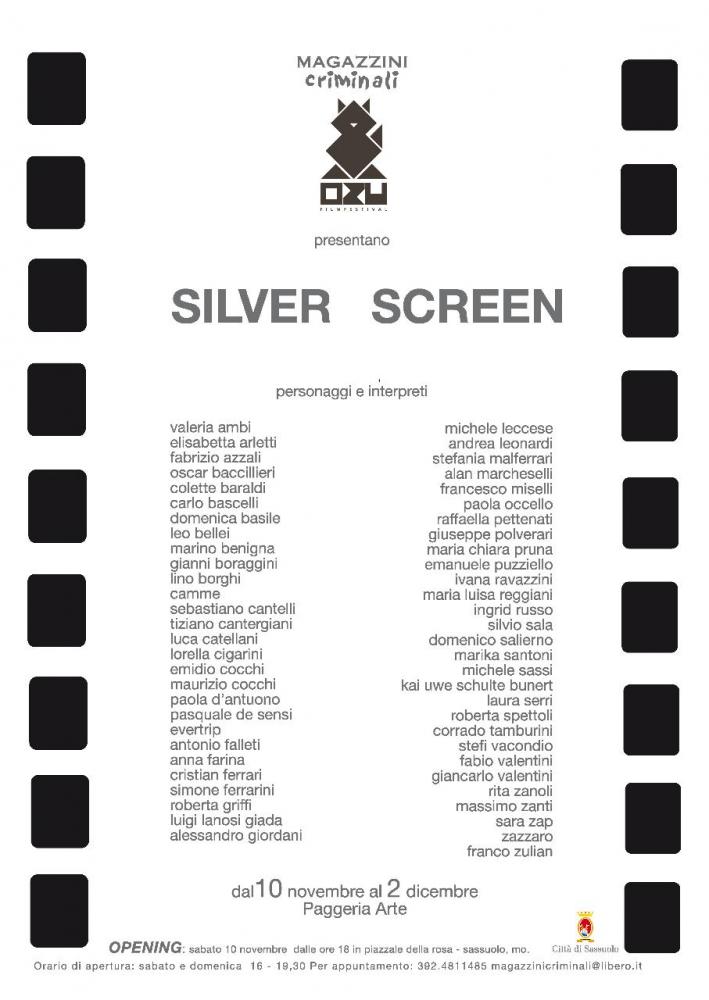
SILVER SCREEN
"Oh, lucky, lucky me,
I shall live in luxury
For I've got a pocketful of dreams. "
[Oh, I'm just fortunato.Vivrò in luxury because I have a pocket full of dreams]
Louis Armstrong
I chose this verse because I think the great Louis Armstrong make good the thought that I have had on cinema and the world that revolves around this might be considered as the "seventh art". I'd like to start from the "Pocket Full of Dreams", pocket full of dreams that enables its possessor to be lucky, feel good, live in luxury, so the luxury of being able to afford to have dreams, to realize, even for a short moment, just long enough of a vision ... And it is precisely by visions, real and invented, mental and experienced, that artists start to give us their fragments of reality ... They can do this with the works of art with the literary and even cinema ... because, as demonstrated by the work of R. Griffi "Cinema is a bit 'like a dream" ... And man has always dreamed of and has "thrown" his pictures, has drawn on cave walls as a reminder of the work of C. Tamburini "Shadows" which brings us back to the origins of cinema as a projection, a sort of first darkroom also celebrated the work of V. Ambi "Darkroom, Praise the light" with which the artist is interested to observe and study the light with a contemplative and poetic approach: the miracle of light and the beauty of its phenomena. We assume that it illuminates what is around us and allows us to see, or a mirror that reflects its surroundings through its presence, everything is light. This element so impalpable (with all its gradations of intensity) "makes the difference" in making us perceive space. And the difference in the perception of sounds made her this time T. Edison when, at the end of 1800, introduced his Kinetoscope, invented to entertain people who listened to the music of his phonograph. It was kind of a big box at the top was an eye the beholder, resting the eye on it and turn the handle, could watch the film on reels mounted in the machine (the English term film showed the film, ie the support. The 35 mm film traveling at a speed of 48 images per second, the film of Eastman Kodak.I first films for the Kinetoscope were the great-grandparents of our short films, in fact lasted a few seconds and showed a still shot with one or more moving subjects. This new way of "seeing", however, was reserved for a single use, alone, will have to wait because the brothers Lumiere cinema becomes "collective fact." Lumière For this new tool it becomes a way to show and an investment more than a commercial optical experiment, they sensed that the public interest was mainly directed towards what was projected and its change, their intent was to capture "the extraordinary in the ordinary" and to do so staged fragments of life daily. reminds us the artist MC Pruna with his "Recipe of the cinema": For this recipe we have to thank the Lumière brothers that December 28, 1895 have cooked for the first time in Paris and today, even with the necessary modifications , retains its magic and delights us every time and enchants us. After that, the history of cinema will expand, embrace other ways narrative, invent other genres but often on their way back because the attempt true of many directors, as Caesar said Zavattini, is not to invent a story that resembles the reality, but to tell the reality as if it were a story. Because, as we demonstrate with his installation A. Leonardi "Reality is Fiction." And do not tell stories Only directors ... painting, photography and cinema are deeply related because the arts of representation and, as such, despite having different historical events, they come in many ways to defile himself ... He knew the director Ozu Yasushiro that his eyes were full of art and dreams, through it is able to give us memorable cinematic masterpieces just because they are linked to a minimal plot, only touched by the great events and guided his reserved nature. director's career can be divided into two parts, torn from the epochal watershed was for him the Second World War.'m just the first film in which it appears as the imprint of Hollywood.'s films are marked by maturity rather a style "contemplative", which almost ignores the rules of cinema and is steeped in symbolism minimal and psychological nuances. A perfectionist, an eccentric for some, did not use the sound until 1935 and likewise his first color film dates back only to 1958. Perhaps this choice was also dictated by the fact that the image changes was a language understandable to all thanks to the culture medium / low of personaggi.Come, medieval artists made use of narratives to pictures on the walls of the cathedrals to be able to catechize the masses, the film is Ozu as a "new religion." It ' was a great admirer of Western cinema, love the films of Ernst Lubitsch, and at the same time one who has handed in a more respectful than anyone traditions and family culture of Japan. Said the director Wim Wenders, who dedicated the film Tokyo-Ga, when asked what it was for him to heaven: "The closest thing to heaven I have ever met is the cinema of Ozu." And as Wenders, are already many artists here have decided to pay homage to the cinema, some taking as its starting point the work of the master Ozu - L. Catellani, C. Bascelli that gives us a pictorial version of a famous still from Ozu film "Tokyo Story" - others paying tribute to America's most famous celebrities like Reggiani ML, A. Falleti, S.Sala - the rest of Hollywood moguls were not wrong when they assumed that the film would offer immediately all'immigrante a way to satisfy himself. This strategy corresponded perfectly to cinematic form that allowed in the twenties of 'boxing' the American way of life "and export all over the world. E the world hurried to get in line to buy canned dreams. cinema not only accompanied the first great era of consumer goods, but it was an incentive and a means of propaganda, already in itself a product of prime importance. then the show's title silver screen dovetails neatly with the concept of cinema as a product and then becomes metonymy film industry. E film as industry image speaks to us in his work I. Ravazzini where are celebrated the most famous movie characters. What the star system is a world in which we are called to rise to new idols, what we forget is that the so-called "stars" are ordinary people, often negative patterns. system of stardom, today priopria true religion, is being challenged by the "RED CARPET" by A. Farina who wants to criticize the film not as a model but says the negative ' artist "is the negative feedback that it has on our valori.Un system set on 'idolatry of other human beings, where the concept of the divine that was once approachable only by holiness and unquestionably ethical values and pure, now focuses on a celluloid based on appearance and aesthetics, where the only goal is in the 'emergence and the show at any cost. "Position ironically critical of the prevailing stardom is also to F. Azzali who in his" Rubik Expresso ". L 'artist shows us a set very bizarre ... where everyone puts his nose. Everybody wants ... if you get a moment of glory. The only unaware of what is the protagonist: the turtle Rubik. then emerge as "Ends' Fragments of Memory "photos of the scene of a short film by D. Salierno and" Coils "by D. Basile trapped the stars of our own E. Arletti tribute to Federico Fellini, L. Bellei with Monica Vitti incommunicable, F. Zulian with Sophia Sophia!. uhh ... my lady! borage and G. Roman Holiday. M. Santoni is an interesting job in the work Wanted; represents some Hollywood stars portrayed in the mug shot after his arrest, some for political , driving under the influence of alcohol. strand that binds on the artistic movements and cinemas are situated the work of R. Spettoli - Der Expressionistische film - a tribute to the artistic movement of German expressionism and film, Fritz Lang, Robert Wiene and Friedrich Murnau, who tried to combine in a single scene in the style of vintage posters for silent and M. Leccese, Death of an eye - makes homage to Salvador Dali and Luis Buonuel. The scene shooting a short film made famous by both entitled "Un Chien Andalou" is one of the first surrealist films of the '20s. Surrealism knew the thought of the philosopher Henri Bergson who in 1911 made a stir with the creative evolution, where the mental processes associated with the cinematic form. Just when extreme mechanization manifested in the factory, in film and in the newspaper, the men seemed to find in the stream of consciousness or interior cinema, a new entry into the world of spontaneity, dreams and personal experiences unique. And surely talking about spontaneity can not miss the reference to children and to the genera for children ... Like the cartoon and the animated film, celebrated the installation of R. Zanoli inspired by the character Stuart Little - A mouse in the leg, Rob Minkoff 1999 by which was taken a number animataed by the characters of the great Walt Disney; L. Serri embroiders her beloved Bambi and S. Vacondio there places it "snow", while A. Giordani uses the white "Snow White" and transforms it into an icon covering it with a plexiglass fluorescent orange risaltar which makes her even more, and pushes the envelope is not just "quiet" a curious dwarf perhaps the other four? .. So still cinema as an instrument of consumption and its implications playful but also disturbing as it shows us also work inspired horror movie of cams and also the tribute "deformed" by F. Valentini to Hitchcock in his "three psycho" and the inevitable homage to Kubrick of Kubrick's A Marcheselli with strangelove and one of his best films or "The Shining" celebrated in the work of M. Benigna. A conclusion can be drawn from all this, the bond is still strong, with Ideology frankesteiniana, based on the myth of the abolition of the death and the illusion of being able to use the technologies of reproduction reality to escape the law of time. To use the words of McLuhan: "Through cinema arrotoliamo the real world on a reel and then unroll like a magic carpet of fantasy" where, as suggested by our artists, Happy Ending (E . Puzziello) are not always obvious and can also always be different because only one There's no end (R. Pettenati) and in the end each of us hopes in the future to be, in the words of Andy Warhol's "world-famous for 15 minutes" or better yet, as we suggest our Baccilieri O., shortening, in just 15 seconds!
Chiara Messori
"Oh, lucky, lucky me,
I shall live in luxury
For I've got a pocketful of dreams. "
[Oh, I'm just fortunato.Vivrò in luxury because I have a pocket full of dreams]
Louis Armstrong
I chose this verse because I think the great Louis Armstrong make good the thought that I have had on cinema and the world that revolves around this might be considered as the "seventh art". I'd like to start from the "Pocket Full of Dreams", pocket full of dreams that enables its possessor to be lucky, feel good, live in luxury, so the luxury of being able to afford to have dreams, to realize, even for a short moment, just long enough of a vision ... And it is precisely by visions, real and invented, mental and experienced, that artists start to give us their fragments of reality ... They can do this with the works of art with the literary and even cinema ... because, as demonstrated by the work of R. Griffi "Cinema is a bit 'like a dream" ... And man has always dreamed of and has "thrown" his pictures, has drawn on cave walls as a reminder of the work of C. Tamburini "Shadows" which brings us back to the origins of cinema as a projection, a sort of first darkroom also celebrated the work of V. Ambi "Darkroom, Praise the light" with which the artist is interested to observe and study the light with a contemplative and poetic approach: the miracle of light and the beauty of its phenomena. We assume that it illuminates what is around us and allows us to see, or a mirror that reflects its surroundings through its presence, everything is light. This element so impalpable (with all its gradations of intensity) "makes the difference" in making us perceive space. And the difference in the perception of sounds made her this time T. Edison when, at the end of 1800, introduced his Kinetoscope, invented to entertain people who listened to the music of his phonograph. It was kind of a big box at the top was an eye the beholder, resting the eye on it and turn the handle, could watch the film on reels mounted in the machine (the English term film showed the film, ie the support. The 35 mm film traveling at a speed of 48 images per second, the film of Eastman Kodak.I first films for the Kinetoscope were the great-grandparents of our short films, in fact lasted a few seconds and showed a still shot with one or more moving subjects. This new way of "seeing", however, was reserved for a single use, alone, will have to wait because the brothers Lumiere cinema becomes "collective fact." Lumière For this new tool it becomes a way to show and an investment more than a commercial optical experiment, they sensed that the public interest was mainly directed towards what was projected and its change, their intent was to capture "the extraordinary in the ordinary" and to do so staged fragments of life daily. reminds us the artist MC Pruna with his "Recipe of the cinema": For this recipe we have to thank the Lumière brothers that December 28, 1895 have cooked for the first time in Paris and today, even with the necessary modifications , retains its magic and delights us every time and enchants us. After that, the history of cinema will expand, embrace other ways narrative, invent other genres but often on their way back because the attempt true of many directors, as Caesar said Zavattini, is not to invent a story that resembles the reality, but to tell the reality as if it were a story. Because, as we demonstrate with his installation A. Leonardi "Reality is Fiction." And do not tell stories Only directors ... painting, photography and cinema are deeply related because the arts of representation and, as such, despite having different historical events, they come in many ways to defile himself ... He knew the director Ozu Yasushiro that his eyes were full of art and dreams, through it is able to give us memorable cinematic masterpieces just because they are linked to a minimal plot, only touched by the great events and guided his reserved nature. director's career can be divided into two parts, torn from the epochal watershed was for him the Second World War.'m just the first film in which it appears as the imprint of Hollywood.'s films are marked by maturity rather a style "contemplative", which almost ignores the rules of cinema and is steeped in symbolism minimal and psychological nuances. A perfectionist, an eccentric for some, did not use the sound until 1935 and likewise his first color film dates back only to 1958. Perhaps this choice was also dictated by the fact that the image changes was a language understandable to all thanks to the culture medium / low of personaggi.Come, medieval artists made use of narratives to pictures on the walls of the cathedrals to be able to catechize the masses, the film is Ozu as a "new religion." It ' was a great admirer of Western cinema, love the films of Ernst Lubitsch, and at the same time one who has handed in a more respectful than anyone traditions and family culture of Japan. Said the director Wim Wenders, who dedicated the film Tokyo-Ga, when asked what it was for him to heaven: "The closest thing to heaven I have ever met is the cinema of Ozu." And as Wenders, are already many artists here have decided to pay homage to the cinema, some taking as its starting point the work of the master Ozu - L. Catellani, C. Bascelli that gives us a pictorial version of a famous still from Ozu film "Tokyo Story" - others paying tribute to America's most famous celebrities like Reggiani ML, A. Falleti, S.Sala - the rest of Hollywood moguls were not wrong when they assumed that the film would offer immediately all'immigrante a way to satisfy himself. This strategy corresponded perfectly to cinematic form that allowed in the twenties of 'boxing' the American way of life "and export all over the world. E the world hurried to get in line to buy canned dreams. cinema not only accompanied the first great era of consumer goods, but it was an incentive and a means of propaganda, already in itself a product of prime importance. then the show's title silver screen dovetails neatly with the concept of cinema as a product and then becomes metonymy film industry. E film as industry image speaks to us in his work I. Ravazzini where are celebrated the most famous movie characters. What the star system is a world in which we are called to rise to new idols, what we forget is that the so-called "stars" are ordinary people, often negative patterns. system of stardom, today priopria true religion, is being challenged by the "RED CARPET" by A. Farina who wants to criticize the film not as a model but says the negative ' artist "is the negative feedback that it has on our valori.Un system set on 'idolatry of other human beings, where the concept of the divine that was once approachable only by holiness and unquestionably ethical values and pure, now focuses on a celluloid based on appearance and aesthetics, where the only goal is in the 'emergence and the show at any cost. "Position ironically critical of the prevailing stardom is also to F. Azzali who in his" Rubik Expresso ". L 'artist shows us a set very bizarre ... where everyone puts his nose. Everybody wants ... if you get a moment of glory. The only unaware of what is the protagonist: the turtle Rubik. then emerge as "Ends' Fragments of Memory "photos of the scene of a short film by D. Salierno and" Coils "by D. Basile trapped the stars of our own E. Arletti tribute to Federico Fellini, L. Bellei with Monica Vitti incommunicable, F. Zulian with Sophia Sophia!. uhh ... my lady! borage and G. Roman Holiday. M. Santoni is an interesting job in the work Wanted; represents some Hollywood stars portrayed in the mug shot after his arrest, some for political , driving under the influence of alcohol. strand that binds on the artistic movements and cinemas are situated the work of R. Spettoli - Der Expressionistische film - a tribute to the artistic movement of German expressionism and film, Fritz Lang, Robert Wiene and Friedrich Murnau, who tried to combine in a single scene in the style of vintage posters for silent and M. Leccese, Death of an eye - makes homage to Salvador Dali and Luis Buonuel. The scene shooting a short film made famous by both entitled "Un Chien Andalou" is one of the first surrealist films of the '20s. Surrealism knew the thought of the philosopher Henri Bergson who in 1911 made a stir with the creative evolution, where the mental processes associated with the cinematic form. Just when extreme mechanization manifested in the factory, in film and in the newspaper, the men seemed to find in the stream of consciousness or interior cinema, a new entry into the world of spontaneity, dreams and personal experiences unique. And surely talking about spontaneity can not miss the reference to children and to the genera for children ... Like the cartoon and the animated film, celebrated the installation of R. Zanoli inspired by the character Stuart Little - A mouse in the leg, Rob Minkoff 1999 by which was taken a number animataed by the characters of the great Walt Disney; L. Serri embroiders her beloved Bambi and S. Vacondio there places it "snow", while A. Giordani uses the white "Snow White" and transforms it into an icon covering it with a plexiglass fluorescent orange risaltar which makes her even more, and pushes the envelope is not just "quiet" a curious dwarf perhaps the other four? .. So still cinema as an instrument of consumption and its implications playful but also disturbing as it shows us also work inspired horror movie of cams and also the tribute "deformed" by F. Valentini to Hitchcock in his "three psycho" and the inevitable homage to Kubrick of Kubrick's A Marcheselli with strangelove and one of his best films or "The Shining" celebrated in the work of M. Benigna. A conclusion can be drawn from all this, the bond is still strong, with Ideology frankesteiniana, based on the myth of the abolition of the death and the illusion of being able to use the technologies of reproduction reality to escape the law of time. To use the words of McLuhan: "Through cinema arrotoliamo the real world on a reel and then unroll like a magic carpet of fantasy" where, as suggested by our artists, Happy Ending (E . Puzziello) are not always obvious and can also always be different because only one There's no end (R. Pettenati) and in the end each of us hopes in the future to be, in the words of Andy Warhol's "world-famous for 15 minutes" or better yet, as we suggest our Baccilieri O., shortening, in just 15 seconds!
Chiara Messori






Comments 4
i like
Say something