Exhibitions, Italy, Bologna, 29 September 2018
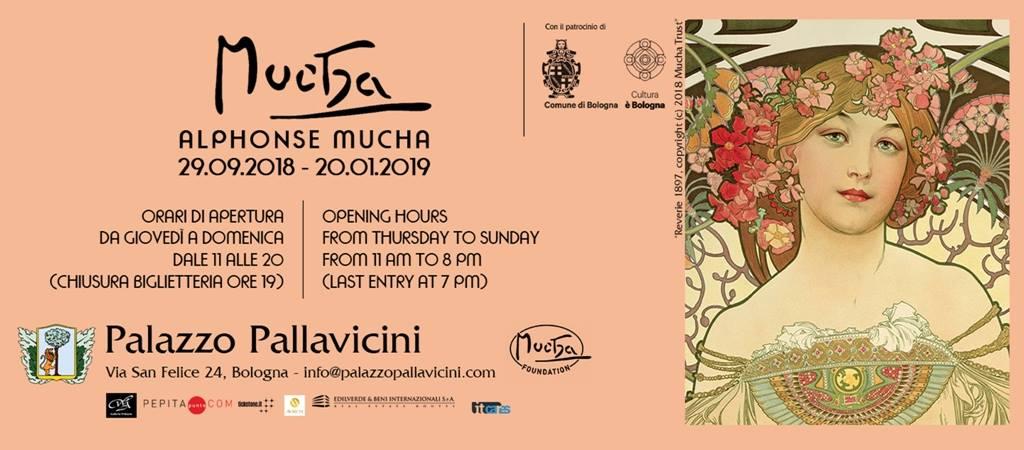
From Saturday 29 September 2018 for the first time in Bologna an important retrospective on the work of Alphonse Mucha, one of the greatest performers of Art Nouveau; until 20 January 2019 the wonderful eighteenth-century halls of Palazzo Pallavicini (Via San Felice 24, Bologna) will frame 80 of the most famous works by the Czech artist, 27 of which are exhibited for the first time in Italy.
The exhibition, organized by Chiara Campagnoli, Rubens Fogacci and Deborah Petroni of Pallavicini srl in collaboration with Mucha Foundation and with the curatorship of Tomoko Sato, puts an unprecedented look on the work of the great artist.
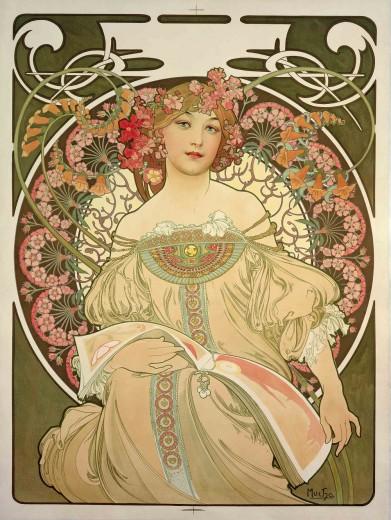
Alphonse Mucha (1860-1939) was one of the most celebrated and influential artists of the Paris fin-de-siècle, known to most for his graphics, as the theatrical posters made for the 'superstar' actress Sarah Bernhardt and her advertising images with elegant and attractive women. Mucha created his own well-defined style - the Mucha style - characterized by harmonious compositions, sinuous shapes, references to nature and calm colors, which became synonymous with the emerging decorative style of the period, the Art Nouveau.
Despite the powerful impact of his style, however, little has ever been known about the ideas on art and aesthetics at the origin of his work. The exhibition itinerary, entitled Alphonse Mucha, examines the theoretical aspects of his works, especially the concept of beauty, the central principle of his art.
With around 80 works selected from those of the Mucha Foundation, the exhibition includes some of the artist's most iconic works, posters and posters from his Parisian period, and also sheds a glance at the artistic language with which Alphonse Mucha expressed his nationalism a returned to his homeland in the last years of his life.
The exhibition consists of three thematic sections: Women - Icons and Muse, Le Style Mucha - A Visual Language, Beauty - The Power of Inspiration.
Women - Icons and Muse, opens with Gismonda, the first real poster designed by Mucha for Sarah Bernhardt. In his representation of the greatest French actress of the period, the Czech artist transforms the "divine Sarah" into a Byzantine goddess. The poster received immediate appreciation as soon as it appeared on the Paris posters on January 1, 1895. Its visual impact - with its elegant elongated shape and the delicate pastel tones that made the actress's image sublime and her balance between simplicity and detail-it was impressive in its originality.
Delighted by the success of this manifesto, Bernhardt offered Mucha a contract to produce the stage sets and costumes, as well as all the posters of her theatrical performances. During this contract, which went from 1895 to 1900, Mucha produced six more posters for Bernhardt's performances, including La dama delle camelie (1896), Lorenzaccio (1896) and La Samaritana (1897).
The success of the Gismonda brought to Mucha also numerous commissions to design advertising posters, including those for famous brands like JOB (cigarette paper), Lefèvre-Utile (biscuits) and Waverley (American bicycles). The section mainly includes two groups of works: theatrical posters on Sarah Bernhardt and advertising posters for commercial products. By carefully studying these works, we explore Mucha's artistic strategies, especially her use of beautiful women as icons and commercial message vehicles. The exhibition also includes some packs and magazine covers.
The second section is entitled Le Style Mucha - A Visual Language.
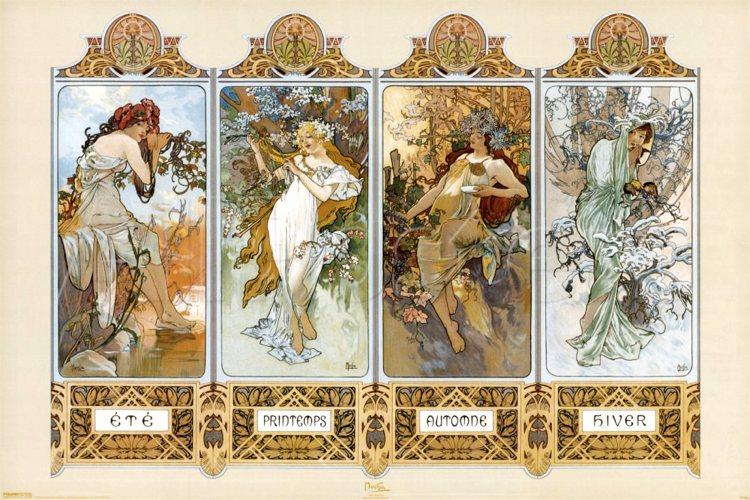
At the time of Mucha, the concept of "art" underwent a revolutionary change with the advent of modernism and also the classical notion of "beauty", one of the foundations of art, was put to the test and changed to embrace new ideas and forms. In such a moment of ferment, Mucha began his research on the universal and unchanging value of art and came to the conclusion that the ultimate goal of the same was the expression of beauty, which could in his opinion be achieved only through harmony between internal contents (ideas, messages) and external forms. As he wrote in his professor's notes, which were published posthumously as Lessons on Art (1975), the artist's role is to inspire people through the harmonious beauty of his works and to raise their quality of life through the his art. To achieve this goal, Mucha developed a particular and characteristic artistic formula, a new communicative language, which used the image of a woman - symbol of her message of beauty - along with flowers and other decorative elements, taken from the Czech folkloristic tradition and other exotic cultures. For Mucha, the ornamental posters (panneaux décoratifs) were the ideal means of achieving his aspiration. Introduced for the first time by Mucha and its publisher, F. Champenoi, , these posters were for the most part devoid of text and made for purely decorative purposes; products in large quantities were immediately available for a large audience, thus becoming an alternative art form that could be shown off even by the most ordinary families. Of these posters, Mucha then wrote: "I was happy to be involved in an art form for people and not just for elegant salons. Cheap art, accessible to the general public and that has found dwelling in the poorest homes as well as in the most influential circles. "The section presents some Mucha decorative posters and explores the ideas behind these works, studying the characteristics of its stylistic figure. It also includes the fundamental decoration manuals of Mucha, Documents Décoratifs (1902) and Figures Décoratives (1905).
Section 3-Beauty-The power of inspiration- closes the exhibition itinerary.
Mucha returned to his homeland in 1910 to realize his dream of actively working for the political freedom of his country, a commitment that culminated in the realization of his work of art, Epopea Slava (1912-1926) and other works that were to inspire unity spiritual of the Slavic peoples.
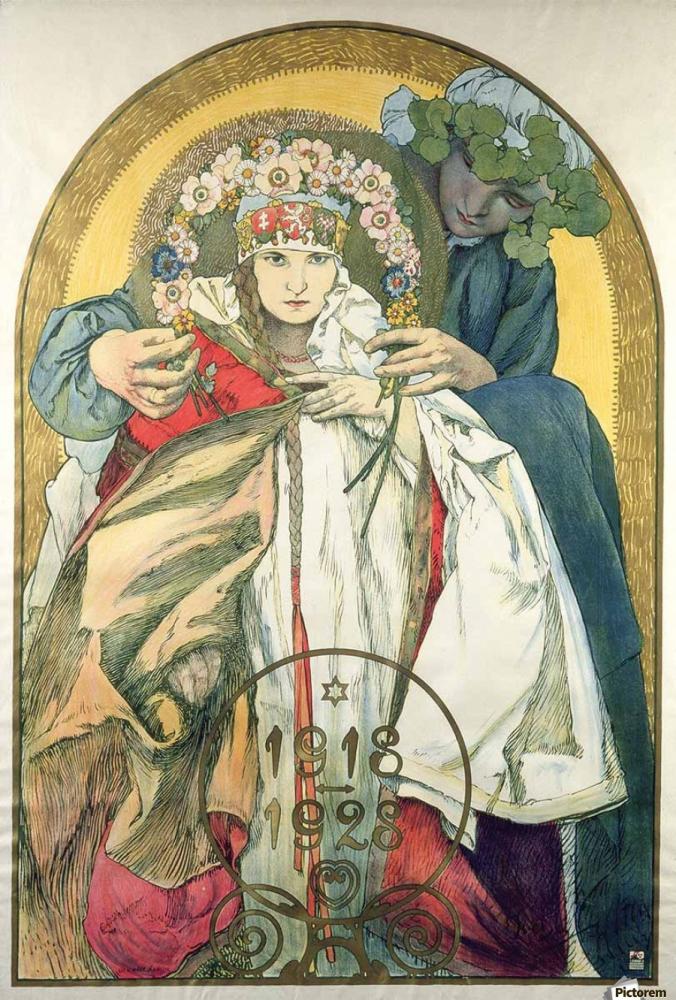
The final section shows examples of Mucha's latest work, exploring how the Mucha style evolved into the art of message creation. The works on display in this last section include studies for the decoration of the then new Prague Town Hall, as well as the poster for the Epic Slav exhibition, held in Prague and Brno on the tenth anniversary of the birth of Czechoslovakia.
Palazzo Pallavicini is an elegant eighteenth-century dwelling, originally from the 15th century, in the heart of ancient Bologna. Inhabited in the past by great noble families, in 1770 it welcomed the performance of the then fourteen-year-old child prodigy Wolfgang Amadeus Mozart. Today the Palace is home to museum exhibitions and events.
The exhibition, organized by Chiara Campagnoli, Rubens Fogacci and Deborah Petroni of Pallavicini srl in collaboration with Mucha Foundation and with the curatorship of Tomoko Sato, puts an unprecedented look on the work of the great artist.
Alphonse Mucha (1860-1939) was one of the most celebrated and influential artists of the Paris fin-de-siècle, known to most for his graphics, as the theatrical posters made for the 'superstar' actress Sarah Bernhardt and her advertising images with elegant and attractive women. Mucha created his own well-defined style - the Mucha style - characterized by harmonious compositions, sinuous shapes, references to nature and calm colors, which became synonymous with the emerging decorative style of the period, the Art Nouveau.
Despite the powerful impact of his style, however, little has ever been known about the ideas on art and aesthetics at the origin of his work. The exhibition itinerary, entitled Alphonse Mucha, examines the theoretical aspects of his works, especially the concept of beauty, the central principle of his art.
With around 80 works selected from those of the Mucha Foundation, the exhibition includes some of the artist's most iconic works, posters and posters from his Parisian period, and also sheds a glance at the artistic language with which Alphonse Mucha expressed his nationalism a returned to his homeland in the last years of his life.
The exhibition consists of three thematic sections: Women - Icons and Muse, Le Style Mucha - A Visual Language, Beauty - The Power of Inspiration.
Women - Icons and Muse, opens with Gismonda, the first real poster designed by Mucha for Sarah Bernhardt. In his representation of the greatest French actress of the period, the Czech artist transforms the "divine Sarah" into a Byzantine goddess. The poster received immediate appreciation as soon as it appeared on the Paris posters on January 1, 1895. Its visual impact - with its elegant elongated shape and the delicate pastel tones that made the actress's image sublime and her balance between simplicity and detail-it was impressive in its originality.
Delighted by the success of this manifesto, Bernhardt offered Mucha a contract to produce the stage sets and costumes, as well as all the posters of her theatrical performances. During this contract, which went from 1895 to 1900, Mucha produced six more posters for Bernhardt's performances, including La dama delle camelie (1896), Lorenzaccio (1896) and La Samaritana (1897).
The success of the Gismonda brought to Mucha also numerous commissions to design advertising posters, including those for famous brands like JOB (cigarette paper), Lefèvre-Utile (biscuits) and Waverley (American bicycles). The section mainly includes two groups of works: theatrical posters on Sarah Bernhardt and advertising posters for commercial products. By carefully studying these works, we explore Mucha's artistic strategies, especially her use of beautiful women as icons and commercial message vehicles. The exhibition also includes some packs and magazine covers.
The second section is entitled Le Style Mucha - A Visual Language.
At the time of Mucha, the concept of "art" underwent a revolutionary change with the advent of modernism and also the classical notion of "beauty", one of the foundations of art, was put to the test and changed to embrace new ideas and forms. In such a moment of ferment, Mucha began his research on the universal and unchanging value of art and came to the conclusion that the ultimate goal of the same was the expression of beauty, which could in his opinion be achieved only through harmony between internal contents (ideas, messages) and external forms. As he wrote in his professor's notes, which were published posthumously as Lessons on Art (1975), the artist's role is to inspire people through the harmonious beauty of his works and to raise their quality of life through the his art. To achieve this goal, Mucha developed a particular and characteristic artistic formula, a new communicative language, which used the image of a woman - symbol of her message of beauty - along with flowers and other decorative elements, taken from the Czech folkloristic tradition and other exotic cultures. For Mucha, the ornamental posters (panneaux décoratifs) were the ideal means of achieving his aspiration. Introduced for the first time by Mucha and its publisher, F. Champenoi, , these posters were for the most part devoid of text and made for purely decorative purposes; products in large quantities were immediately available for a large audience, thus becoming an alternative art form that could be shown off even by the most ordinary families. Of these posters, Mucha then wrote: "I was happy to be involved in an art form for people and not just for elegant salons. Cheap art, accessible to the general public and that has found dwelling in the poorest homes as well as in the most influential circles. "The section presents some Mucha decorative posters and explores the ideas behind these works, studying the characteristics of its stylistic figure. It also includes the fundamental decoration manuals of Mucha, Documents Décoratifs (1902) and Figures Décoratives (1905).
Section 3-Beauty-The power of inspiration- closes the exhibition itinerary.
Mucha returned to his homeland in 1910 to realize his dream of actively working for the political freedom of his country, a commitment that culminated in the realization of his work of art, Epopea Slava (1912-1926) and other works that were to inspire unity spiritual of the Slavic peoples.
The final section shows examples of Mucha's latest work, exploring how the Mucha style evolved into the art of message creation. The works on display in this last section include studies for the decoration of the then new Prague Town Hall, as well as the poster for the Epic Slav exhibition, held in Prague and Brno on the tenth anniversary of the birth of Czechoslovakia.
Palazzo Pallavicini is an elegant eighteenth-century dwelling, originally from the 15th century, in the heart of ancient Bologna. Inhabited in the past by great noble families, in 1770 it welcomed the performance of the then fourteen-year-old child prodigy Wolfgang Amadeus Mozart. Today the Palace is home to museum exhibitions and events.





Comments 0
Say something